One system model instead of schemas and service contracts
Quote and bind processes are usually spread across services, databases and the contracts between them, so every rule change becomes a development project. A single versioned system model holds the whole state machine instead.

Most quote and bind processes were not designed as one thing. They grew. A portal was built to capture the application. A validation service was added when errors became expensive. A KYC provider was integrated, then a rater, then a link to the CRM. Each piece has its own database, its own data model and its own idea of where a case is.
That works until something needs to change. This article looks at why it gets harder over time, and at the alternative: describing the whole process as one versioned system model.
How the process ends up spread out
Each service in a typical setup is reasonable on its own. The trouble is in the lines between them.
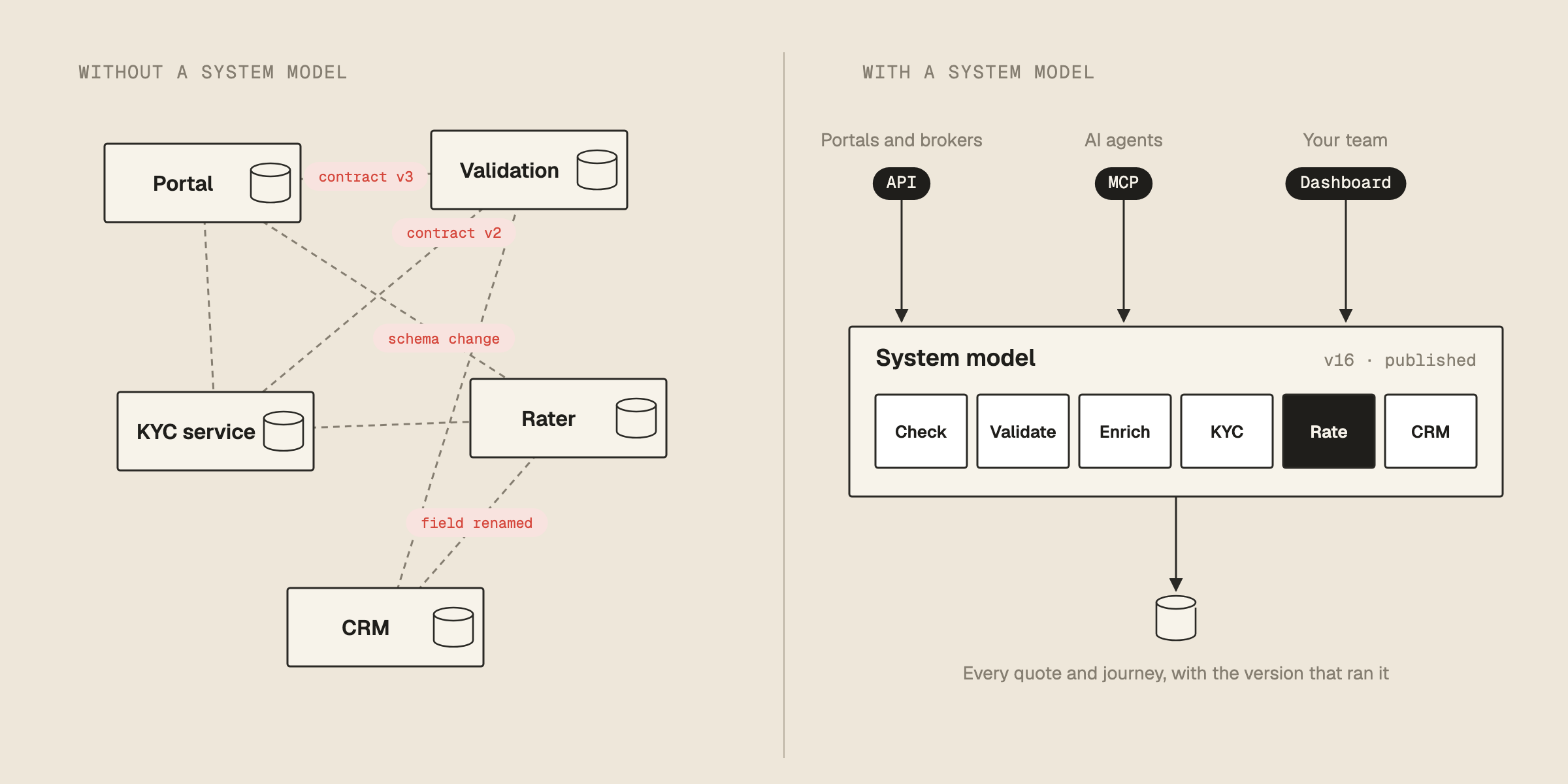
On the left, the state of a case is split across five databases. The rules are split too: some checks live in the portal, some in the validation service, some in the rater. Each connection is a contract that both sides must keep to, and the contracts change at different times.
A small business change shows the cost. Suppose the business wants to accept applicants a year younger than before. That rule may need changes in:
- the portal, so the form accepts the new age;
- the validation service, so the check passes;
- the rater, so it has a price for the new age;
- the database schemas behind each, if a field changes;
- the contracts between them, so nothing rejects the new value;
- the tests for each service, and a coordinated release.
A one-line business decision becomes a development project across several teams. Because it is expensive, changes are batched, and the people who own the rules wait for a release slot.
What a system model is
A system model describes the whole process in one place: the modules, the rules inside each, the order they run in, and what each one returns. It is the state machine written down, in a form that a platform can run directly.
On the right of the diagram, the portals, AI agents and staff all reach the same model, and every run writes to the same record. The model itself is the contract between them.
This changes three things.
- There is one definition of the process. The rules for a case live in one model, so there is no question of which service holds the true version.
- There is one record of each case. Every quote and journey is saved with its inputs, outputs and lights, and with the version of the model that produced it.
- Rule changes are model changes. Changing the age limit is an edit to a rule in the Check module, not a coordinated release.
Versions, not releases
Because the model is one thing, it can be versioned as one thing. Each version carries a short summary of what changed, so the history reads like a change log the business can understand.
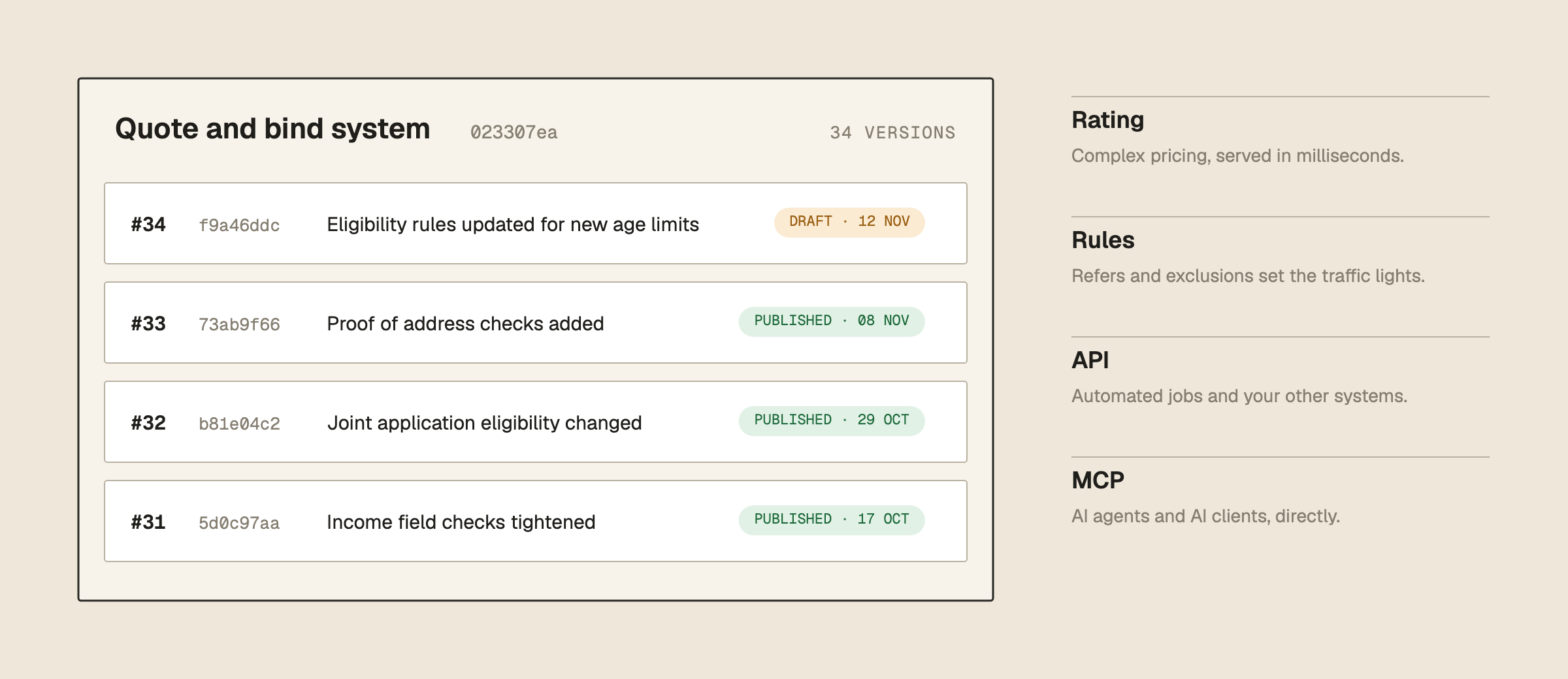
Each module is versioned too. A system model version records which version of each module it uses, so you can tell exactly which Check rules and which rates applied to any quote.
How a change goes live
A version moves through its own small state machine.
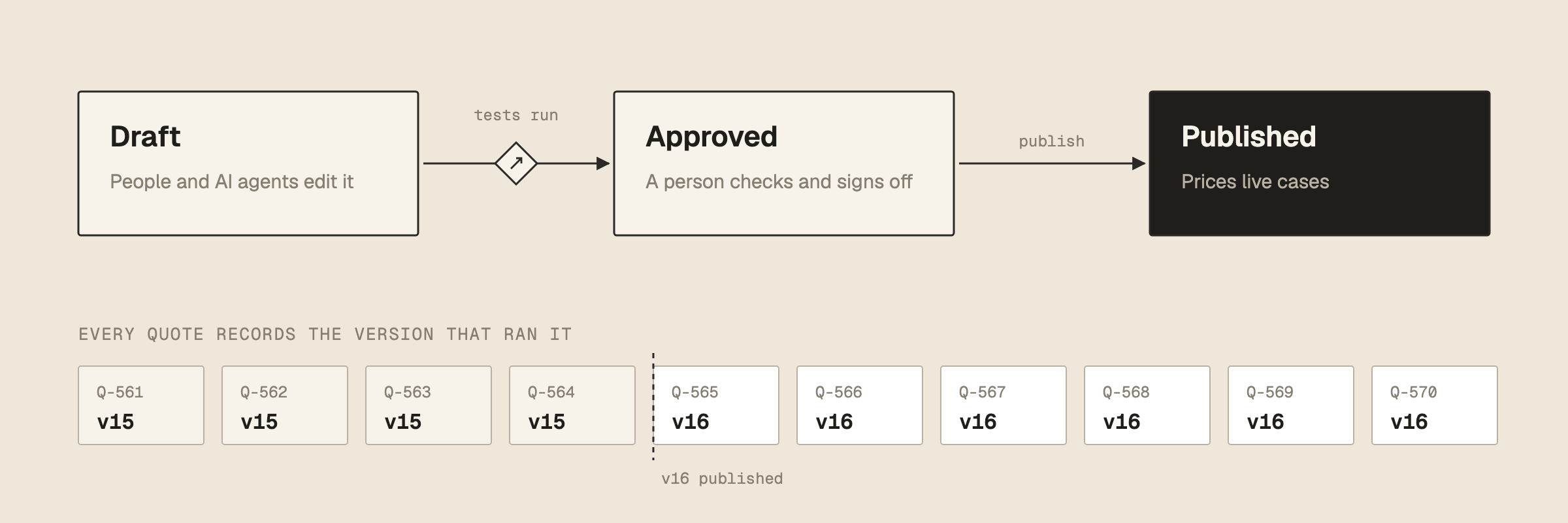
- Draft. People, and AI agents if you allow them, edit a working copy. Nothing live is touched.
- Tested. Each version carries a set of test cases with expected results. A change that moves a result shows up before it goes anywhere. Our guide to testing pricing models covers how to build these.
- Approved. A person checks the change, the test results and the reason, and signs it off.
- Published. The version starts handling live cases. The previous version stays available if you need to go back.
From the moment a version is published, every quote records it. When someone later asks why two similar cases were treated differently, the first thing to check is which version ran each one.
What you no longer manage
Moving to a system model does not remove engineering work. Portals still need building and outside data still needs connecting. It does remove three recurring costs:
- Changing database schemas. The record of each quote holds its inputs and outputs as they were sent and returned, so adding a field to the model does not mean migrating a table in every service.
- Several service contracts. Callers use one API or one MCP server. The model defines what goes in and what comes out.
- Rule changes as a development task. The people who own the rules can change them in a draft, with tests and approval, without waiting for a release.
Who owns what
A system model also makes ownership clearer. Engineering owns the connections: the portals, the integrations and the outside data sources. The business owns the rules: what is checked, what is referred, what is declined and how cases are priced. Risk and compliance can see both, because both are recorded in one place.
How this is done in Ptally
Ptally is a rating and rules state machine, and the system model is how you describe it. Rating is one module; the checks, referrals and binding around it are in the same model.
- One model, built from modules. A system model runs other models as steps. Each module is a project with its own versions and tests, so a team can own one module without touching the rest.
- Versions with summaries. Every version has a status (draft, approved, published) and a summary of the change. Every quote records the version that produced it.
- Tests on every version. Each version holds its own tests with expected results, and they can be run at any time, including by an AI assistant through the
run_version_teststool on our MCP server. - People approve and publish. AI agents can edit drafts through MCP, but approving and publishing are done by people in the dashboard. Every status change is recorded. Our guide to approving and publishing walks through it.
- One API and one MCP server. Callers send inputs and get back outputs, lights and the rules that fired, documented on the API page. The model is the contract.
- Your cloud or ours. Ptally can run as a managed service or inside your own cloud account.
For the basics of states, events and lights, start with what a state machine is.
Getting started
If a simple rule change in your quote process needs several teams and a release, describe the process as it runs today to your AI client and build it on Ptally as one system model. There is no implementation fee and nothing to pay upfront. Talk to our team.